
Four Lines of Sight

Boards often rely only on oversight, missing opportunities to add value through insight, foresight, and hindsight. This article provides a framework to help directors choose the best lens to elevate the quality of boardroom thinking.
Board directors spend time looking closely at their organization – reviewing reports, checking performance, and ensuring compliance. Board discussions feel thorough and responsible.
But if you’ve ever walked out of a board meeting thinking, “Good discussion … but something was missing,” you’re not alone.
That feeling might come from everyone in the room viewing information in the same way, through the same lens, and along the same line of sight.
Boards benefit greatly when directors look at information differently, using a variety of lenses across different lines of sight. Doing so allows modern boards to move beyond monitoring performance to be more future-focused, think more creatively, and extract wisdom from past experience.
As directors, there’s a mental model that helps us see board issues in different ways. We call it the Four Lines of Sight.
A Director’s Mental Model
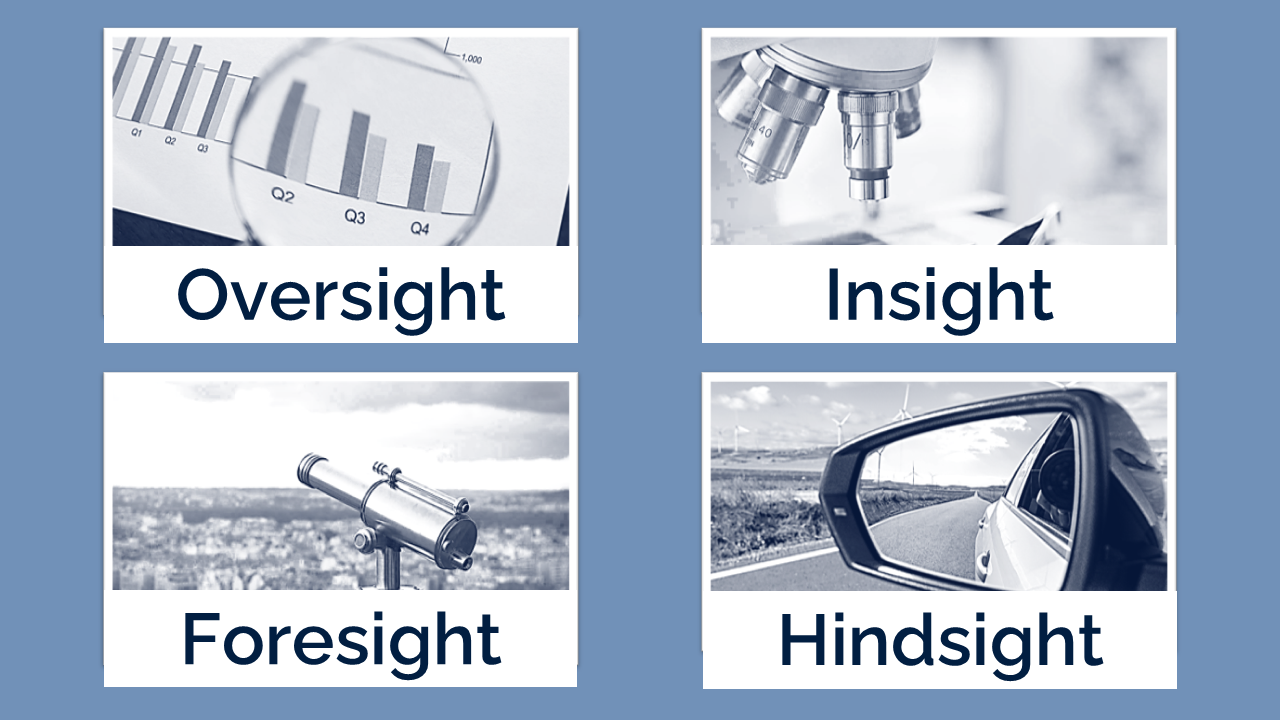
A mental model is a simple framework for understanding how something works. Using the Four Lines of Sight as a mental model gives directors a powerful way of understanding their role through four distinct lenses:
- Oversight – protecting the organization.
- Insight – challenging and advising.
- Foresight – preparing for the future.
- Hindsight – learning from experience.
Each lens reflects a different mindset. All four are essential to an effective board, but most boards overuse the oversight lens and underuse the other three.
The key to making use of the Four Lines of Sight framework is to intentionally choose the lens that best suits the task at hand. Let’s explore each lens before moving on to selecting the appropriate one for the situation.
Oversight – Setting the Foundation
Oversight is the fiduciary lens, built on prudence and healthy skepticism.
Oversight is where boards spend most of their time. It involves monitoring performance, ensuring compliance, managing risk, and safeguarding assets. Oversight matters a lot to directors – but it’s not the only way of seeing.
One of our earlier Savvy Director blogs, The Importance of Being Compliant, exemplifies the oversight lens.
An Oversight Scenario
Management presents quarterly results showing revenue slightly below plan. Directors ask, “What’s driving the variance? What corrective actions are underway?”
Oversight Questions for the Savvy Director
- How does actual performance compare to plan, and why?
- What risks are emerging that we may not have fully accounted for?
- How confident are we in the assumptions behind these numbers?
- What would concern us most if this trend continues?
Insight –Adding Real Value
Insight is the generative lens, built on curiosity, exploration, and reframing.
Insight moves the board beyond monitoring into drawing meaning from data. It’s where directors help management think differently, not just report differently. Insight opens doors that oversight alone cannot.
To dig deeper into the insight lens, refer to the Savvy Director blog, The Power of Catalytic Questions.
An Insight Scenario
Management proposes entering a new market. Directors explore, “What assumptions are we making about customer behavior? What alternatives were considered?”
Questions for the Savvy Director
- What assumptions are we making that could be wrong?
- What are we not seeing – or not talking about?
- What other options should we be considering?
- If we approached this from scratch, what might we do differently?
Foresight – Preparing for Tomorrow
Foresight is the strategic lens, focused on long-term resilience and opportunity.
Foresight looks ahead – scanning trends, disruptions, and emerging scenarios. Foresight turns the board from a rear view mirror to a radar system.
It’s easy to neglect the foresight lens because what’s urgent tends to crowd out what’s important. But failing to look ahead is its own risk.
The Savvy Director blog Thinking About Now, Next, and Beyond demonstrates the foresight lens in action.
A Foresight Scenario
The discussion shifts from current performance to future disruption. Directors consider, “What could challenge our business model? What capabilities will we need in 2-5 years?”
Questions for the Savvy Director
- What might change in our environment over the next few years?
- What threats could significantly disrupt the way we do business?
- What opportunities are we not yet positioned to capture?
- What do we need to start doing now to succeed in the future?
Hindsight – Turning Experience into Wisdom
Hindsight is the reflective lens, focused on learning from the past.
Hindsight closes the loop between action and wisdom. It isn’t about blame, it’s about learning. This lens helps directors examine what happened, why it happened, and how to make better decisions next time.
Our blog Internal Audit – Your Eyes and Ears shows how internal audit – which is usually viewed as a compliance and risk management function – can be used to activate the hindsight lens by switching the focus from control to improvement.
A Hindsight Scenario
A major project underperforms. Directors probe, “What assumptions didn’t hold? What signals did we miss?”
Questions for the Savvy Director
- What did we learn from this that we should carry forward?
- What assumptions proved incorrect – and why?
- What early warning signs did we overlook?
- How should this experience change the way we make decisions?
The Right Lens for the Task
Knowing which lens to use is a skill that comes with experience. There are two opportunities for you to make this choice – while you’re preparing for the meeting and during the meeting itself.
Before the Meeting
It’s easier to contribute meaningfully when you’ve thought about which lens each agenda item needs. Don’t just skim the material and be done with it. Go a step further by matching the lens to the item. This will set you up to ask stronger questions and contribute with intention, not guesswork. Here’s how.
Oversight. Use this lens during prep when the agenda includes:
- financial reports, dashboards, and KPIs.
- compliance updates or policy approvals.
- risk reports or internal audit findings.
- operational performance summaries.
Clues in the board package include trend lines, variances, budget comparisons, detailed data with little narrative, and anything entitled monitoring, reporting, or compliance. Ask yourself, “What should I verify, challenge, or clarify to fulfill my fiduciary duties?”
Insight. Use this lens during prep when the materials:
- introduce a complex decision or ambiguous issue.
- include multiple options or scenarios.
- raise questions that don’t have clear answers.
- describe an opportunity that requires deeper exploration.
Clues include inconsistent data or assumptions that don’t add up, a problem statement that feels narrow or incomplete, and recommendations that would benefit from reframing. Ask yourself, “How can I help illuminate the issue rather than just approve or decline it?”
Foresight. Use this lens during prep when you see:
- strategic discussions or environmental scans.
- long‑range capital plans or capability-building proposals.
- shifting market, regulatory, or technological landscapes.
- decisions that will shape the organization for years.
Clues in the material include minimal discussion of external trends, heavy focus on current performance with little mention of future impact, or a strategic plan that hasn’t been revisited recently. Ask yourself, “What future trends, disruptions, or opportunities should we consider before deciding this?”
Hindsight. Use this lens during prep when reviewing:
- post‑implementation reviews.
- project close‑outs.
- unexpected results (positive or negative).
- lessons-learned summaries.
Clues in the package include explanations of what happened but not why it happened, reports that focus only on outcomes, not on process or assumptions, or repeated issues that suggest unexamined patterns. Ask yourself, “What can we extract from this experience that will make future decisions better?”
During the Meeting
In the moment, start by paying attention to the signals in the board discussion so you can recognize which lens the moment calls for. Here are some cues to help you choose the right lens intentionally.
Oversight. If the question is “Are we on track?” you’re in oversight territory. Use this lens when:
- You’re looking at reports, metrics, or variances.
- The discussion is about compliance, performance, or policy.
- You hear phrases like “Is this within tolerance?” or “Does this meet our obligations?”
Insight. If the conversation is stuck in analysis but not understanding, it’s time for insight. Use this lens when:
- Something needs reframing or digging into.
- The problem is unclear or the decision feels rushed.
- You hear phrases like “I feel like we’re missing something” or “What’s behind this?”
Foresight. If the board is only talking about what is, someone needs to ask about what could be. Use the foresight lens when:
- Everyone is focused on today, but the implications live in the future.
- Decisions being made now will shape the next 2–5 years.
- You hear “We’ll worry about that later” or “Let’s just get through this quarter”.
Hindsight. If you’re closing out a cycle – win or loss – hindsight is the teacher. Use this lens when:
- A project didn’t go as planned and you hear “Let’s not make this mistake again.”
- A project exceeded expectations and, amid the congratulations, no one asks "How did we achieve this?".
- You need to understand cause and effect, not assign blame.
Once you’ve recognized the need, you can shift your own thinking intentionally. To guide the board’s conversation toward the lens you want, use a carefully thought-out question or two.
- For oversight, ask questions that verify and challenge.
- For insight, ask questions that explore and reframe.
- For foresight, ask questions that anticipate and prepare.
- For hindsight, ask questions that reflect and learn.
Elevate Your Next Board Meeting
- Scan the agenda. Where’s the focus? Oversight often dominates. What’s missing?
- Prepare across all four lines of sight. Don’t show up with only oversight questions. Bring curiosity, creativity, and forward thinking.
- Shift the conversation in real time. One well-timed question can move the board from analysis to insight, or from today’s issues to tomorrow’s risks.
Your takeaways:
- Oversight is essential, but not sufficient.
- Foresight isn’t just an annual topic, but a standing discipline.
- Experience isn’t valuable unless you extract the lesson.
- Being a savvy director isn’t just about what you know, it’s about how you think, and help others think.
- The most effective directors don’t just look through one lens, they intentionally switch lenses to see across different lines of sight.
Resources:
- The 3 Lines of Sight: Hindsight, Oversight, and Foresight (4/10). David R. Beatty. Achieving Board Excellence. © 2026 David R. Beatty.
- Formula for Board Directors: Oversight, Insight, Foresight. Jeffrey S. Perry. Lead Mandates LLC. January 2025.
- On Governance: Balancing Directors’ Hindsight, Insight, and Foresight for Board Composition and Effectiveness. Patrick Dailey. The Conference Board Inc. May 2018.
- The 4 lines of sight for successful businesses. Paul Roberts. Medium. January 2017.
- Why boards must focus on insight and foresight in today’s volatile world. Nick Staunton. European Business Magazine. August 2023.
- What Great Boards Do: Oversight, insight and Foresight. Tamara Paton. © Tamara Paton International Inc.
Thank you.
Scott
Scott Baldwin is a certified corporate director (ICD.D) and co-founder of DirectorPrep.com – an online membership with practical tools and valuable insights designed for directors at every stage – from first appointment to seasoned board leader.
We Value Your Feedback: Share your suggestions for future Savvy Director topics.
Comment

Scott Baldwin, ICD.D
Co-founder | Director
Scott is a knowledge entrepreneur, certified corporate director (ICD.D), and leader of a board advisory firm. He is recognized as an advisor and educator who helps boards and directors in virtually every sector improve their structure, processes, and dynamics.

